Introduction
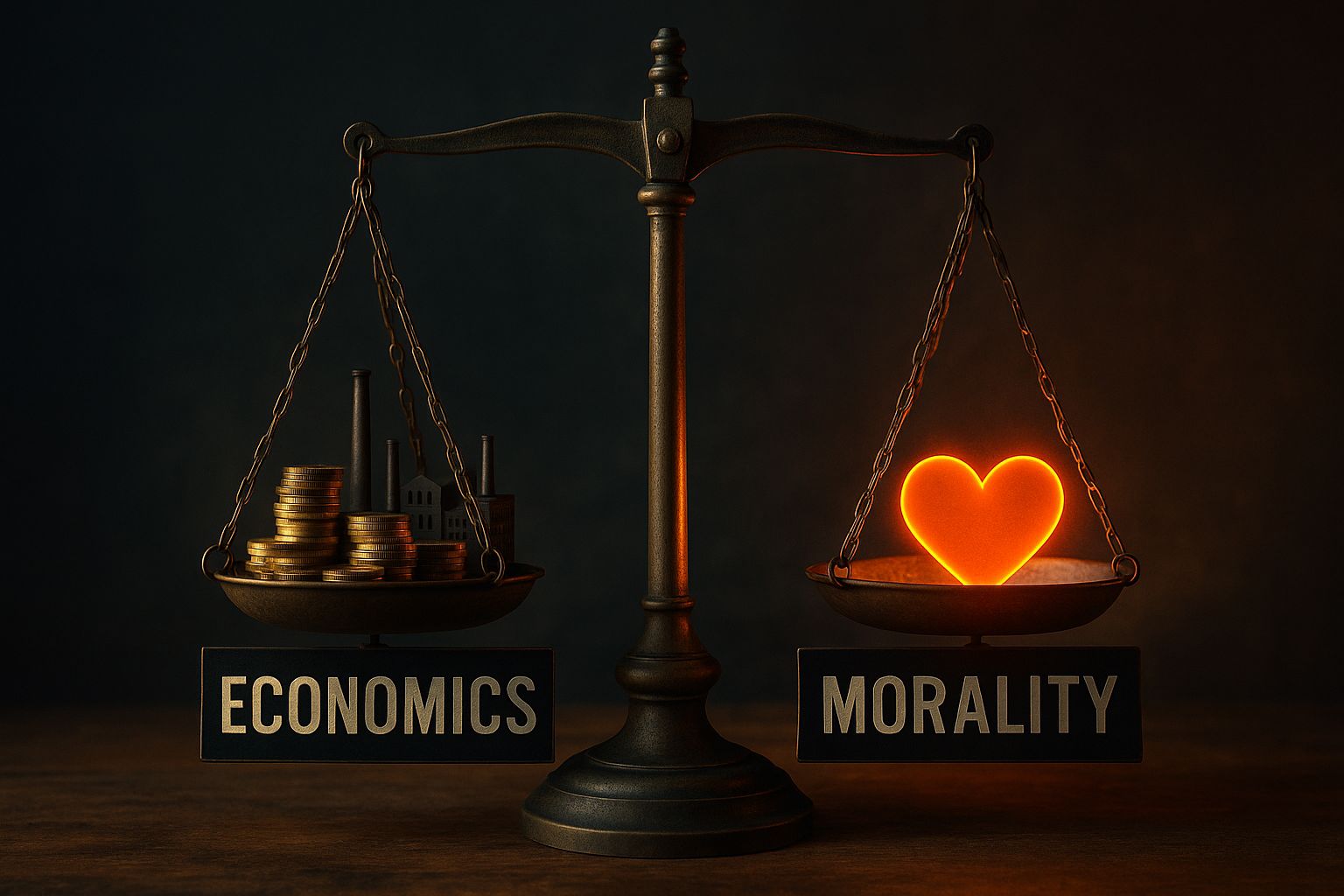
We tend to measure progress in numbers — GDP, growth, technology. The economy seems to drive history, while morality quietly follows. But in truth, it’s the other way around: morality and economy are not equal in strength. The economy grows out of relationships, trust, and cooperation — without morality, it cannot exist. Every economic crisis is first of all a crisis of human values and trust.
Development Is Not Economy, but Relationships
It is often said that morality is just a reflection of economic forces. That child labor disappeared not because it was immoral, but because it became unprofitable. That slavery ended not out of compassion, but because machines proved cheaper. That women’s rights advanced because new industries required their labor.
This is a convenient theory. It explains everything and — most importantly — removes personal responsibility. If morality is just a by-product of economics, we can say: “We’re not to blame, life is just like that.” As technologies change, economies change, and morality changes with them.
But this reverses cause and effect. The economy doesn’t create morality — it arises from technological development, which in turn is born of relationships between people.
Agricultural societies and industrial societies do require different economic systems, yes. But it wasn’t the rise of agriculture that united people into communities — rather, it was the emergence of more cohesive, cooperative groups that made agriculture possible in the first place. Humans lived for millions of years without farming, and nothing forced them to change until their internal relationships evolved — toward sharing, planning, and trust.
After that, the process worked in both directions: agriculture strengthened social ties, and those ties fueled further development. But the starting point was always human relationships, not what they produced.
And this raises a deeper question: if technologies and economies eventually become available to all, why do they appear only in some places first? Perhaps the true driver of progress lies not in climate or resources, but in the values that allow trust, curiosity, and freedom to flourish.
The economy doesn’t generate morality; it reflects the level of moral relationships that already exist between people.
Moral Values Do Not Come from the Economy
Adopting a new economic model doesn’t automatically change a society’s values. History shows the opposite: the same economic systems can produce completely different outcomes, because each culture adapts its economy to its own moral foundation.
France and North Korea both speak the language of social justice, yet their societies could not be more different. In France, social ideas are realized through democracy and accountability; in North Korea, through obedience and fear. Identical slogans about equality and collectivism have produced opposite realities — because the decisive factor wasn’t ideology, but the moral values behind it.
The same is true for capitalism. Swedish capitalism is based on trust, fairness, and shared responsibility; Somali capitalism is about survival and power. The form is the same, but its moral content changes everything.
The twentieth century proved this once again. Communism promised equality, solidarity, and justice — but in societies where power outweighed people, it turned into its opposite. It wasn’t the idea that created dictatorship, but the values that placed structure above humanity. The same words — “justice,” “equality,” “freedom” — can mean liberation or oppression, depending on the moral world they grow from.
Modern China offers another example. It has borrowed Western technologies and market logic but not Western moral foundations. The result is impressive growth built on fear, hierarchy, and dependence. Such progress is only an illusion — because true development transforms knowledge and wealth into human freedom.
Economy is a tool, a mirror, a form — never the source. It can serve people if it reflects moral order, or destroy them if it replaces it. Societies do not become moral by adopting the “right” economy. They become stable only when their moral values shape the economy, not when the economy tries to replace morality.
What Are Values, and Can They Change?

To say that morality changes is to confuse form with substance. Circumstances change, not essence. Love, friendship, compassion, and loyalty existed long before philosophy or religion. We see them in animals that have no economy or language. These are not cultural inventions, but natural mechanisms of cooperation and survival. Only the context of their expression changes.
When people say, “In the past, humans were cruel — they beat children, they oppressed women,” they overlook the fact that there were always others. Tribes where women led, nations where life was valued above profit. Every era has had both kindness and cruelty; the question is only which becomes the norm.
Morality is not an invention of civilization — it is a property of life itself. Values do not arise from economic systems; they merely take on new forms of expression. The economy shows not what our principles are, but how deeply we have learned to understand ourselves.
People often claim that economic development makes society more humane: that we become “better” as we grow richer and safer. It sounds persuasive — but only if we accept the Christian idea that humans are born sinful and must gradually redeem themselves. We built this view ourselves: we declared humanity flawed, and then proudly began to “improve” it.
It’s a comforting thought — it excuses us. We can be imperfect now because “we’ll be better later,” when we reach a higher level of development. But Aletophany argues the opposite: a person can be good at any moment — just as they can be evil. Morality does not wait for progress; it depends not on circumstances, but on choice.
Perhaps that is what the ancients meant when they wrote that “God gave man free will.” Animals follow instinct — their behavior is natural. Humans can act against nature — both in harm and in kindness. That conscious capacity for moral choice is what defines humanity.
Goodness does not come from development — it is woven into the fabric of life. We see empathy and care among animals with no religion or economy. Meanwhile, as civilization advances, our cruelty grows more sophisticated. We perfect technology but continue to kill each other — now with greater efficiency and justification.
So perhaps “moral progress” is nothing more than civilization’s self-justification. Maybe we are not becoming better — we are merely inventing new ways to think of ourselves as good.
Morality and Development
True development begins not with technology or economic reform, but with the moral choice that a society makes. Progress is not measured by factories, universities, or startups, but by the ability of people to trust each other, keep promises, and see value in every human being.
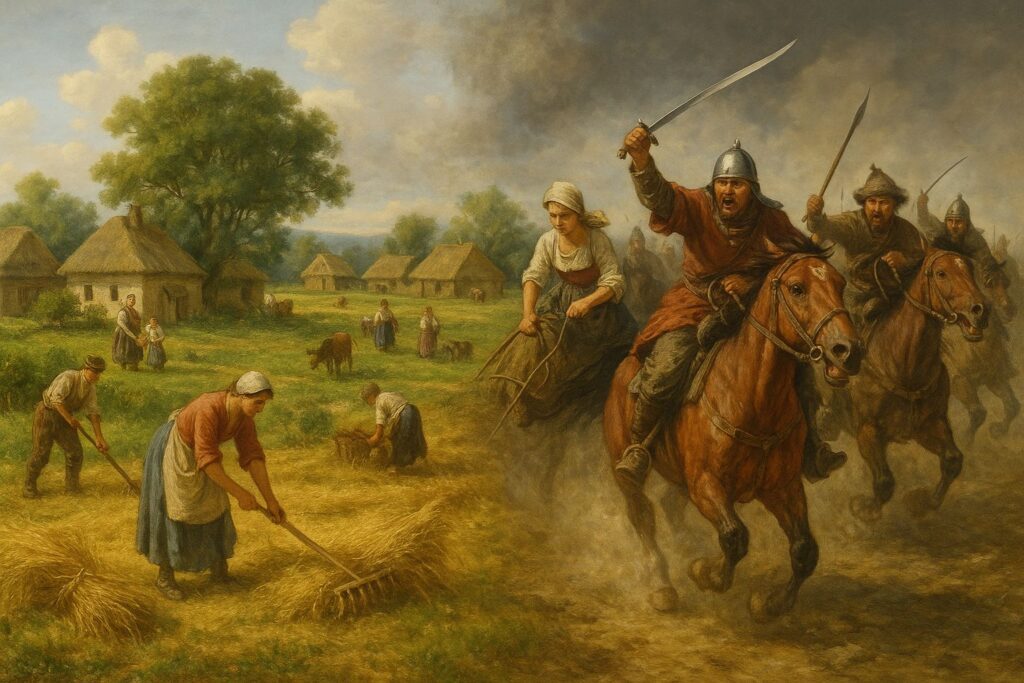
History shows that where morality collapses, progress stops; and where honesty, responsibility, and respect endure, growth follows naturally. Not because such societies are smarter or richer, but because trust and moral norms create the environment where creativity becomes possible.
Morality is the invisible infrastructure of development. It cannot be built from steel or concrete, and it does not appear in statistics, but without it, there can be no science, no economy, no culture. When a society begins to justify lies, violence, or humiliation in the name of “higher goals,” everything else — laws, institutions, and markets — crumbles after it.
Development is not an automatic process; it is a moral choice of civilization. Some nations choose cooperation and rise. Others choose fear and control — and descend into decay, gaining power but losing meaning.
So we may say: the truly developed is not the one who grows richer, but the one who becomes more humane.
At first glance, it sounds like a beautiful phrase. But development is not just moving from carts to cars, or from abacuses to computers. It began with the brain — and the brain could not have evolved without moral principles: empathy, cooperation, care for others. These became the foundation of complex behavior and consciousness.
Perhaps these same principles still drive our progress today — only on a new scale. To become a “new humanity,” we don’t need a new morality. We need to become the kind of humans who can develop without losing their morality.
Conclusion
The economy explains how we live, but only morality explains why. Numbers describe growth, but never meaning. When morality and economy go hand in hand, humanity builds culture, science, and the future. When they diverge, we become a society that can produce everything — except goodness.
True progress begins not in banks or laboratories, but in the heart — where we choose between profit and conscience. The world will change not when it becomes richer, but when it once again believes that morality is stronger than the economy.
«Aletophany is written by two minds: Andrei Tsetserau and ChatGPT.»