Introduction
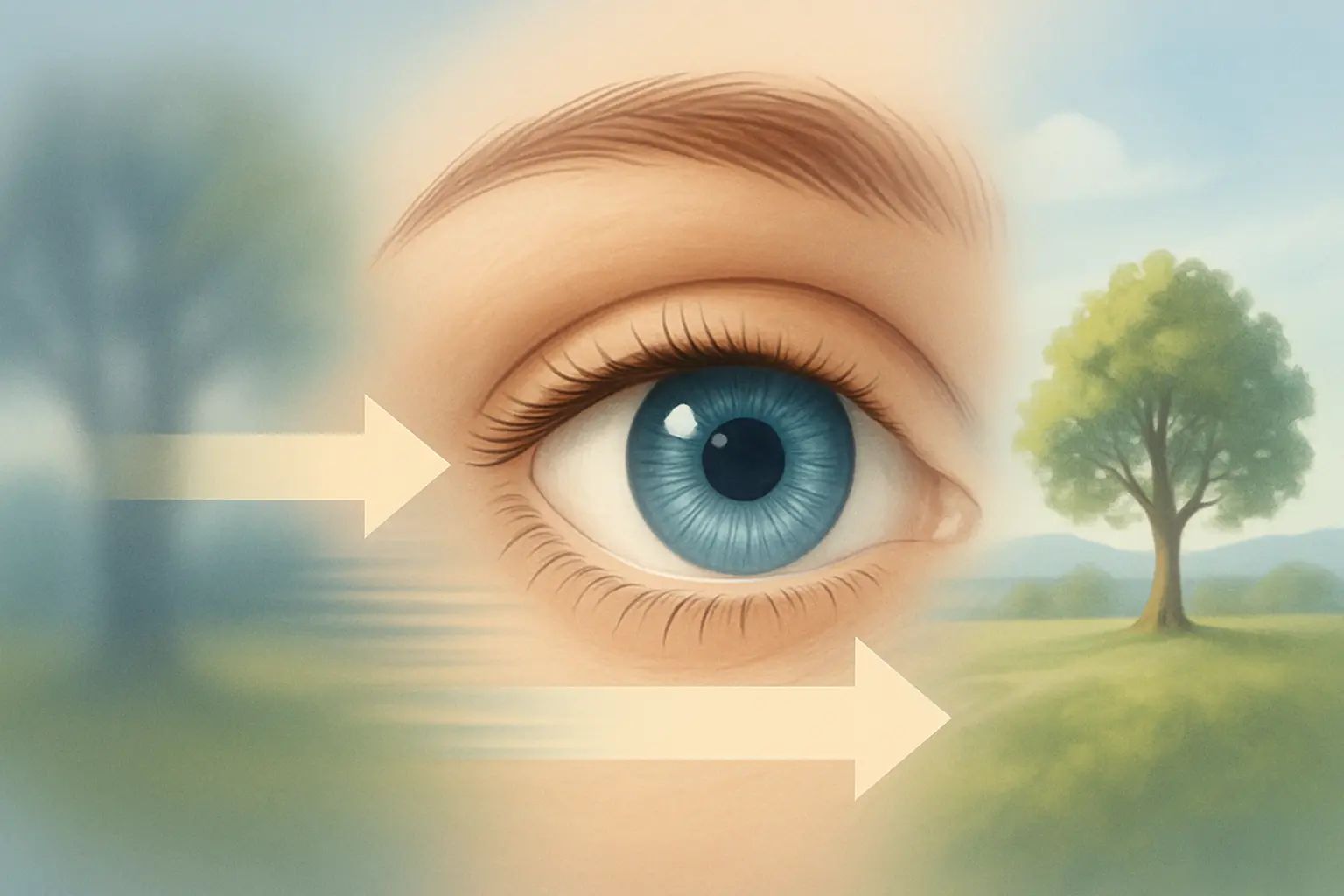
In today’s world, myopia (nearsightedness) is becoming an increasingly widespread issue. Traditional methods of correction, such as glasses and contact lenses, merely compensate for the symptoms without addressing the root cause of vision deterioration. The foundation of this new concept for natural vision restoration is the idea that the eye’s natural, evolutionarily intended state is to focus on distant objects.
Evolutionary Justification
The human eye evolved under conditions where the primary visual scenario was observing objects at great distances (e.g., tracking prey or detecting danger). Over time, the visual system adapted to naturally remain in a state of relaxed focus aimed at faraway objects. Close-up viewing occurred only occasionally and for short durations, which meant the eye muscles primarily developed to enable temporary focus on near objects before returning to their relaxed state.
Why Myopia Develops: The Harmful Habit of Near Focus
Modern living conditions are vastly different from those in nature. From early childhood, a child’s space is confined by walls, narrow rooms and corridors, and crowded cityscapes. In such environments, the habit of focusing on nearby objects forms early and solidifies quickly. In addition to these physical limitations, psychological factors can contribute to myopia. For instance, a child may subconsciously avoid looking into the distance due to stress, conflicts with teachers or peers, or an unwillingness to see things that are unpleasant or anxiety-inducing. As a result, the tendency to look only at close objects—like a parent’s face, toys, books, or phone screens—becomes dominant and leads to gradual physical changes in the structure of the eye.
Essence of the Method
A key understanding of this approach is that the eye does not have muscles that can consciously tense in order to focus on distant objects. The eye muscles only work in one direction: from the relaxed state of infinity focus toward the tense state of close-up focus. Constant near work leads to chronic tension and fixation of the muscles in a near-focus position, preventing them from returning to their natural relaxed state. To correct myopia, it is necessary to unlearn the deeply rooted habit of near focus and maintain new visual patterns long enough for the eye to physically adapt and return to its original shape and function.
Physiological Basis
The eye’s muscles are responsible solely for shifting focus from distant to near objects. They cannot be consciously activated to improve distance vision. To restore sight, conditions must be created where the eye naturally relaxes and resets its focus to the far distance.
Psychological Basis
People often mistakenly try to improve sharpness by straining their eyes, which only worsens the issue. This method takes the opposite approach: rather than forcing the eye to “see better,” one must create the right conditions for the eye to relax on its own and see clearly without effort.
Description of the Principle
The method is based on the following principles:
- Regular distance viewing: Daily exposure to relaxed and natural looking into the distance.
- Avoidance of visual strain: Consciously avoiding efforts to “see” distant objects.
- Creating habits that support relaxed focusing: Integrating gentle visual routines into everyday life.
These principles are simple to implement, require no special equipment, and demand little time.
Advantages of the New Approach
- Evolutionary alignment: Based on the natural functioning of the visual system.
- Addressing the root cause: Aims to eliminate the underlying reason for myopia.
- Simplicity and accessibility: Easy to apply and doesn’t require devices.
- Lasting effect: Supports long-term vision improvement by restoring natural focus.
Conclusion
The “Fundamental Point of View” project invites people to rediscover and reclaim their eyes’ natural state of relaxed distance focus, offering a real chance for natural vision restoration and permanent improvement. By returning to the evolutionary design of human vision, we gain a powerful tool to overcome the modern epidemic of myopia. We invite you to try this method and experience its simplicity and effectiveness for yourself.
Written in collaboration with ChatGPT, an AI language model developed by OpenAI, and Andrei Tsetserau.