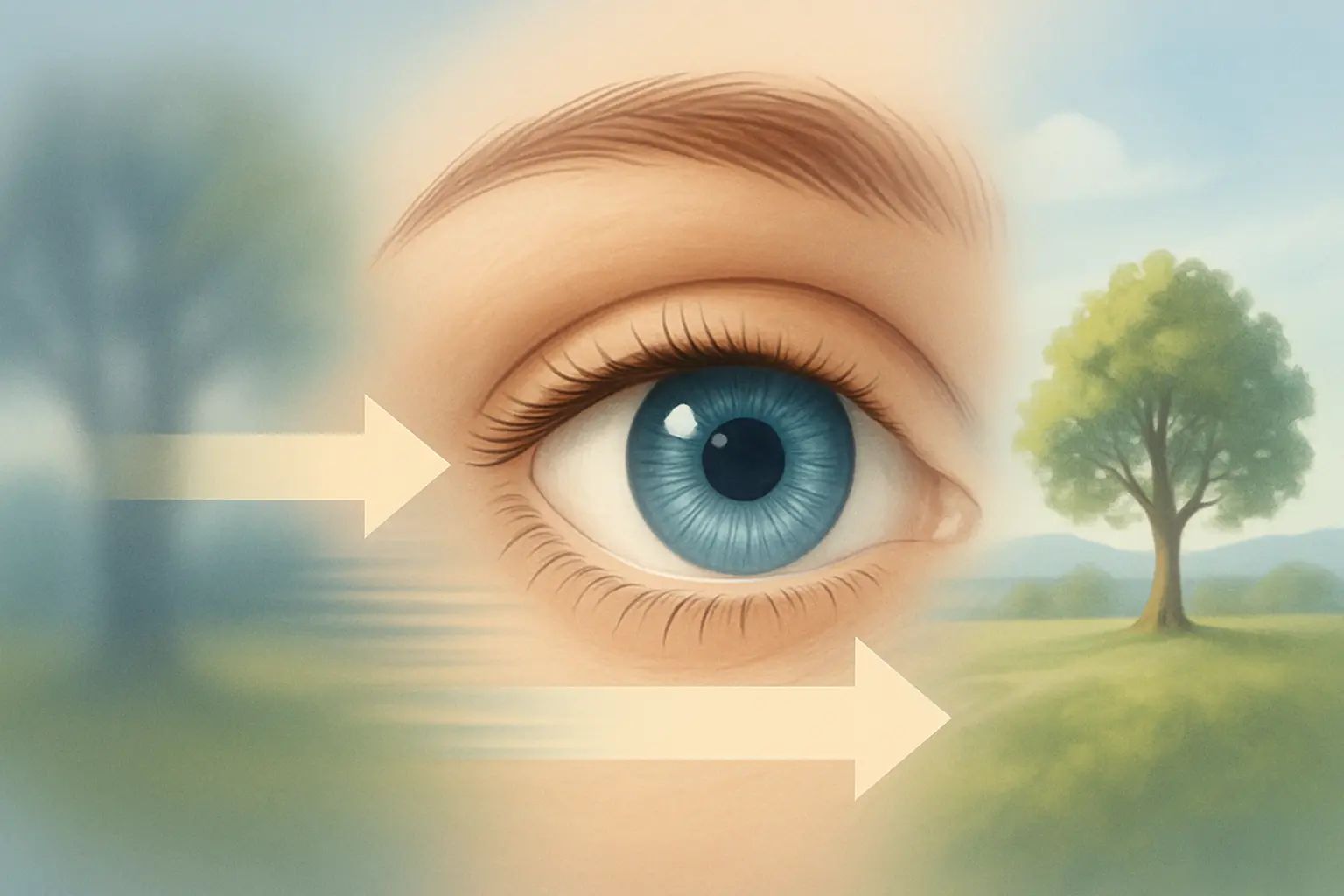
The human eye possesses a unique mechanism of automatic eye focusing based on the physiology of the eye muscles. In normal, unimpaired vision, the eye's default state is a relaxed gaze into the distance. The eye muscles are designed in such a way that they can only adjust focus from distant objects to those that are closer. That is, they work in one direction — contracting to bring the focal point closer to the eye. These muscles cannot push the eye to focus farther into the distance — the far point is the eye’s natural relaxed state.
When there's a need to quickly and clearly see an object, the eye automatically "resets" to this natural infinity point, after which the muscles gradually contract to focus at the required distance. This is why a fast and conscious gaze begins from the far position — from where the muscles can most efficiently reach the desired focal point.
In cases of myopia (nearsightedness), this default setting of the eyes shifts and becomes fixed at a closer distance. This new state becomes the new "default point." Accordingly, even if a nearsighted person starts to see better at long distances during relaxation or exercises, when they try to consciously and quickly focus on a distant object, the eye automatically resets to the familiar near focal point, losing the gained clarity.
This peculiarity leads to a feeling of instability in vision improvement, as it seems to disappear with any attempt to actively look at something far away. In reality, these temporary improvements are genuine, but the eye keeps returning to its familiar, reprogrammed near focus.
Therefore, successful vision restoration requires regular and prolonged practice of returning the eyes to their natural, relaxed state with a default focus on infinity — gradually overwriting the close-range setting and restoring the default focus to a distant point.
Written in collaboration with ChatGPT, an AI language model developed by OpenAI, and Andrei Tsetserau.