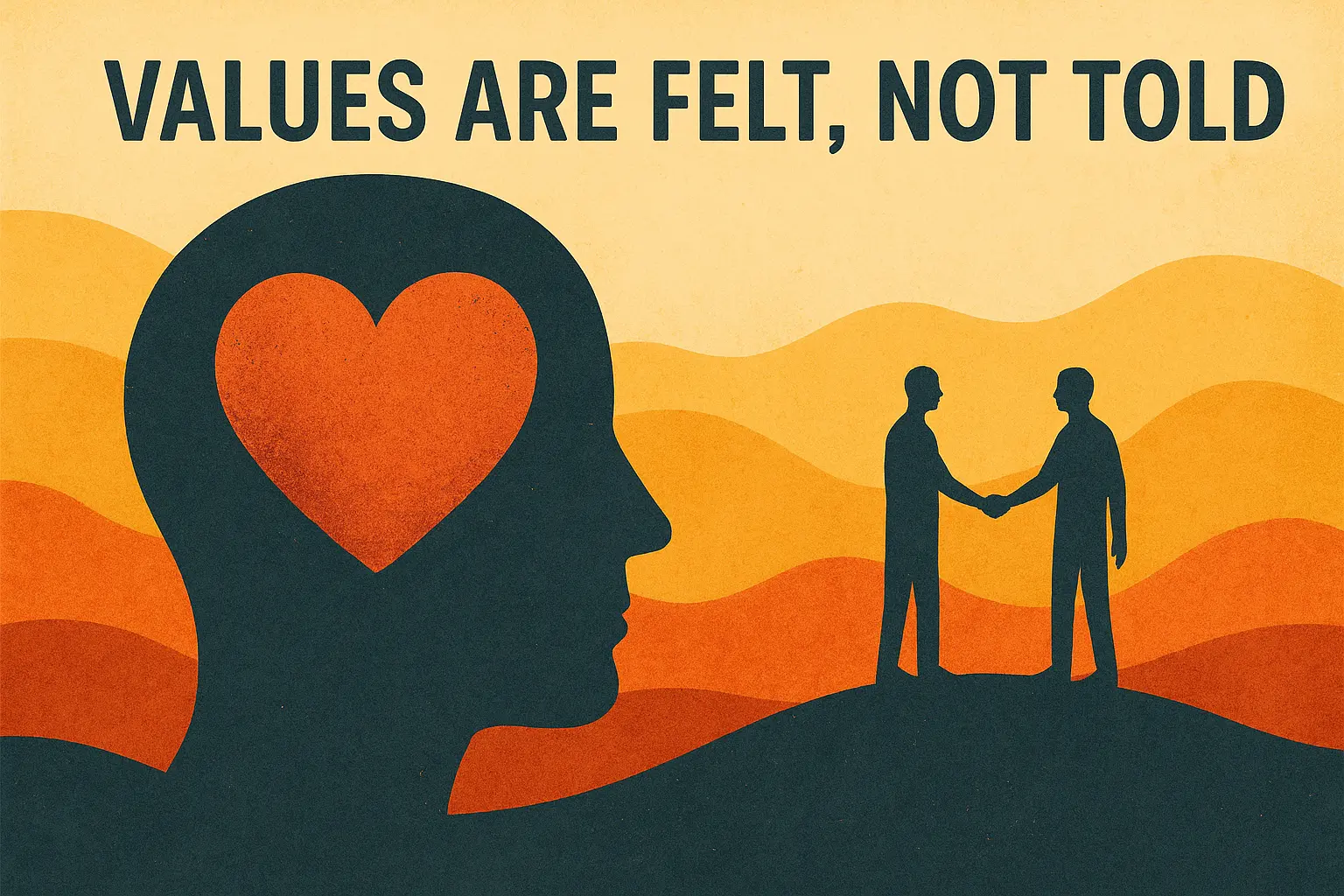
We tend to think of values as something imposed from the outside — a set of rules we learn from family, school, society, or religion. But in reality, values are not what we’re told. Values are what we feel, even if we can’t always put them into words.
From the Paleolithic to the Megacity
In the Paleolithic era, people lived in small groups of 20–30 individuals. Everyone knew each other personally, and each person had direct obligations to the rest. The principle was simple: you help me — I help you. Any outsider was viewed with suspicion: if they weren’t part of our group, they might be dangerous. This way of life worked for millions of years but had a limit — large groups simply couldn’t hold together.
Over time, it became clear that living in larger collectives was more efficient: more resources, more protection, more opportunities. But how do you unite people who don’t know each other personally? This is where values came in — at first in the form of religious norms, and later in more secular forms.
How a Value-Based Society Works
In today’s world, we all belong to multiple social circles: family, workplace, hobby clubs, sports teams, online communities. These circles change — we move, change jobs, switch hobbies, meet new people. But at the core of their stability lies a value-based principle:
A person is “one of us” by default, as long as they share our values.
This is the opposite of the Paleolithic principle: they’re an outsider until they prove otherwise. In a value-based society, we do good not only for those we know personally. I can help a stranger — because I know that another stranger will help me. It works like an extended exchange: not a direct “you for me, me for you,” but a chain of mutual aid, where each person contributes because they share a common idea of what’s right.
The Risk of One-Sided Play
Of course, there will always be people who take advantage of this principle — receiving without giving back. That’s inevitable. But their number depends directly on how strongly society condemns such behavior. People want to be good — or at least appear good. If “not giving back” is considered shameful, such cases become rarer.
Why Values Can’t Just Be Imposed
Values only work if they live inside us. We can talk endlessly about morality and good deeds, but if a person doesn’t feel that it’s right, they won’t live by it. True values aren’t slogans on a wall or lines in a constitution — they’re something a person experiences as part of themselves.
The Choice Is Ours
If we want to live in a large, open, and efficient society, we need shared values that we uphold not out of obligation, but from inner conviction. If we’re ready to give that up, the road back to small, isolated groups is always open. But that’s not a step toward the future — it’s a return to the past.