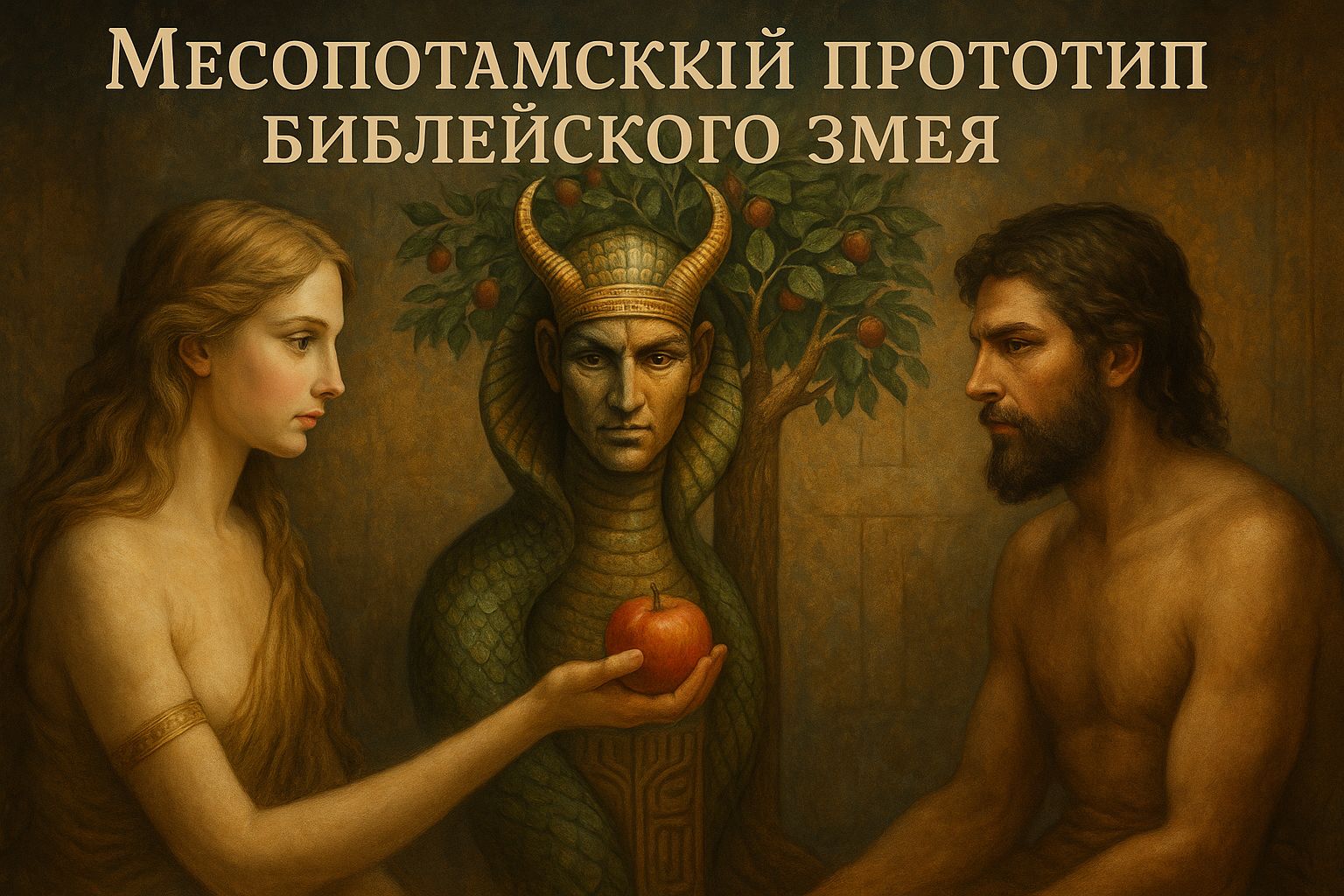
Introduction
The serpent in the Book of Genesis is traditionally viewed as a symbol of evil and the source of humanity’s fall. Yet archaeology, comparative mythology, and the study of ancient Near Eastern religious traditions reveal a far more complex picture. In the earliest cultures, serpent symbolism was not negative but deeply sacred, associated primarily with the feminine principle, moral authority, and the natural order. In many cases, these motifs can be traced back to what modern scholars describe as the Mesopotamian prototype of the biblical serpent.
This article explores a key moment in ancient religious evolution—the emergence of a male deity within a sphere that for millennia belonged exclusively to women. This transition is discussed in detail in our previous article on the shift of sacred authority (Rethinking the Story of the Fall: A Metaphor for Governance and the Loss of Balance).
1. The Serpent-Goddess: The Earliest Form of Female Sacred Power
Archaeological evidence from Çatalhöyük, Vinča, Sialk, Crete, Egypt, and proto-Mesopotamian cultures shows that the serpent originally symbolized the feminine sacred principle. It embodied:

- wisdom and natural law,
- control over birth and death,
- renewal and immortality,
- fertility and chthonic power,
- the moral order of the world.
The serpent-goddess and the female priesthood formed a unified sacred system in which women held moral and ritual authority—the very authority later encoded in the biblical concept of "knowing good and evil."
2. The Emergence of Ningishzida: An Early Male Figure in a Female Sacred Domain
One of the earliest known examples of a male deity entering a traditionally female religious sphere is Ningishzida—a Mesopotamian god of the 3rd millennium BCE. He is depicted either as a human figure with sacred serpents rising from his shoulders, or as a horned divine serpent.

His imagery merges the masculine with the ancient serpent symbolism previously associated almost exclusively with feminine divinity. This marks one of the earliest moments when a male figure (or deity) begins to occupy a role within a sacred sphere once dominated by the serpent-goddess and women priests.
Ningishzida was associated with:
- guarding the threshold between worlds,
- mediating life and death,
- wisdom and fertility,
- symbols traditionally tied to the feminine sacred power.
His rise within religious symbolism reflects an early stage of transformation: male figures appear within the domain of female sacred authority. This is not yet patriarchy—but it is a significant shift.
3. The "Man–Woman–Tree–Serpent" Motif in Mesopotamian Iconography
Cylinder seals from the post-Akkadian period depict a recurring composition: a man and a woman positioned on either side of a sacred tree, with a serpent rising behind the woman. This motif appears in several forms and is sometimes interpreted as a cultural precursor to the biblical Eden scene.
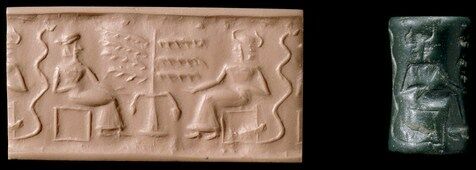
However, its original meaning reflects the dynamics of sacred authority rather than a story of moral transgression:
- the woman represents the ancient moral and ritual authority linked to the serpent-goddess,
- the man appears as a newcomer—an emerging participant in the sacred sphere.
The serpent behind the woman symbolizes her ancestral sacred power. The male figure nearby signals the beginning of a structural shift in religious authority.
4. How This Motif Entered Biblical Tradition
The biblical author inherited this ancient symbolism but reinterpreted it within a new social and religious context. The serpent becomes a vehicle for expressing the loss of an earlier balance and the rise of a different model of authority.
In the older symbolic system:
- the woman held the moral function,
- the serpent was her sacred ally,
- the tree symbolized law, structure, and cosmic order.
The biblical adaptation transforms this complex system into a narrative about the transfer of moral authority from woman to man. In this light, the "fall" becomes not a spiritual error but the moment when male authority takes over a domain previously held by women.
5. What This Transition Meant
Historical evidence from Mesopotamia shows a gradual shift from female priesthoods to male-controlled religious structures. The emergence of male serpent-deities like Ningishzida is part of this broader transformation.
This transition was accompanied by:
- political centralization,
- the rise of male priestly institutions,
- changes in women’s roles,
- reinterpretation of ancient myths.
The iconic scene of a man and a woman divided by a sacred tree, with a serpent behind the woman, reflects the beginning of this shift. This dynamic later becomes the foundation for the biblical story of Eden, where the loss of balance between feminine and masculine roles leads to humanity’s expulsion from “paradise”—a metaphor for social and spiritual harmony.
Conclusion
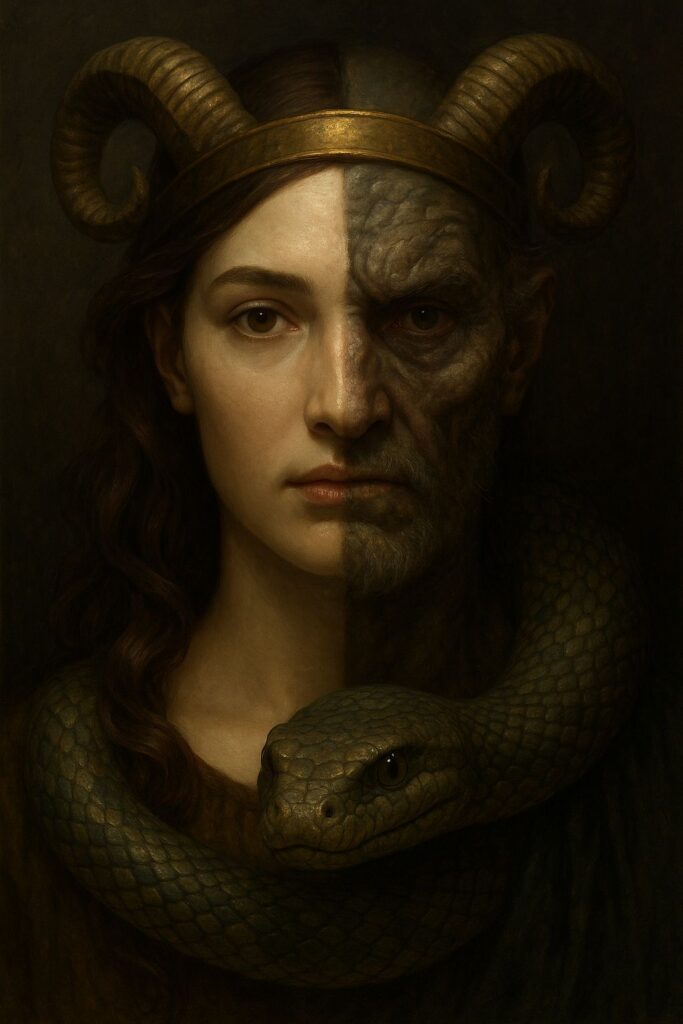
The serpent in the biblical narrative is not merely a tempter. It embodies cultural memory of an ancient conflict between two systems of sacred authority: the feminine moral tradition and the emerging male claim to that role.
The imagery of Ningishzida, the horned serpent, and the motifs of cylinder seals from the 3rd millennium BCE suggest that the biblical serpent reflects a real historical transformation. In this sense, these Mesopotamian symbols preserve the Mesopotamian prototype of the biblical serpent, revealing the deep roots of this shift.
Sources and References
- Jacobsen, Thorkild. The Treasures of Darkness: A History of Mesopotamian Religion. Yale University Press.
- Kramer, Samuel Noah. History Begins at Sumer. University of Pennsylvania Press.
- Black, J., Cunningham, G., Robson, E., Zólyomi, G. The Literature of Ancient Sumer. Oxford University Press.
- Leick, Gwendolyn. A Dictionary of Ancient Near Eastern Mythology. Routledge.
- Dalley, Stephanie. Myths from Mesopotamia: Creation, the Flood, Gilgamesh, and Others. Oxford World's Classics.
- Keel, Othmar. The Symbolism of the Biblical World. Eisenbrauns.
- Parpola, Simo. The Roots of the Tree of Knowledge: Archaeological and Iconographic Evidence from Mesopotamia.
- Frankfort, Henri. Kingship and the Gods. University of Chicago Press.
- Wiggermann, Frans. Mesopotamian Protective Spirits. Brill.
«Aletophany is written by two minds: Andrei Tsetserau and ChatGPT.»