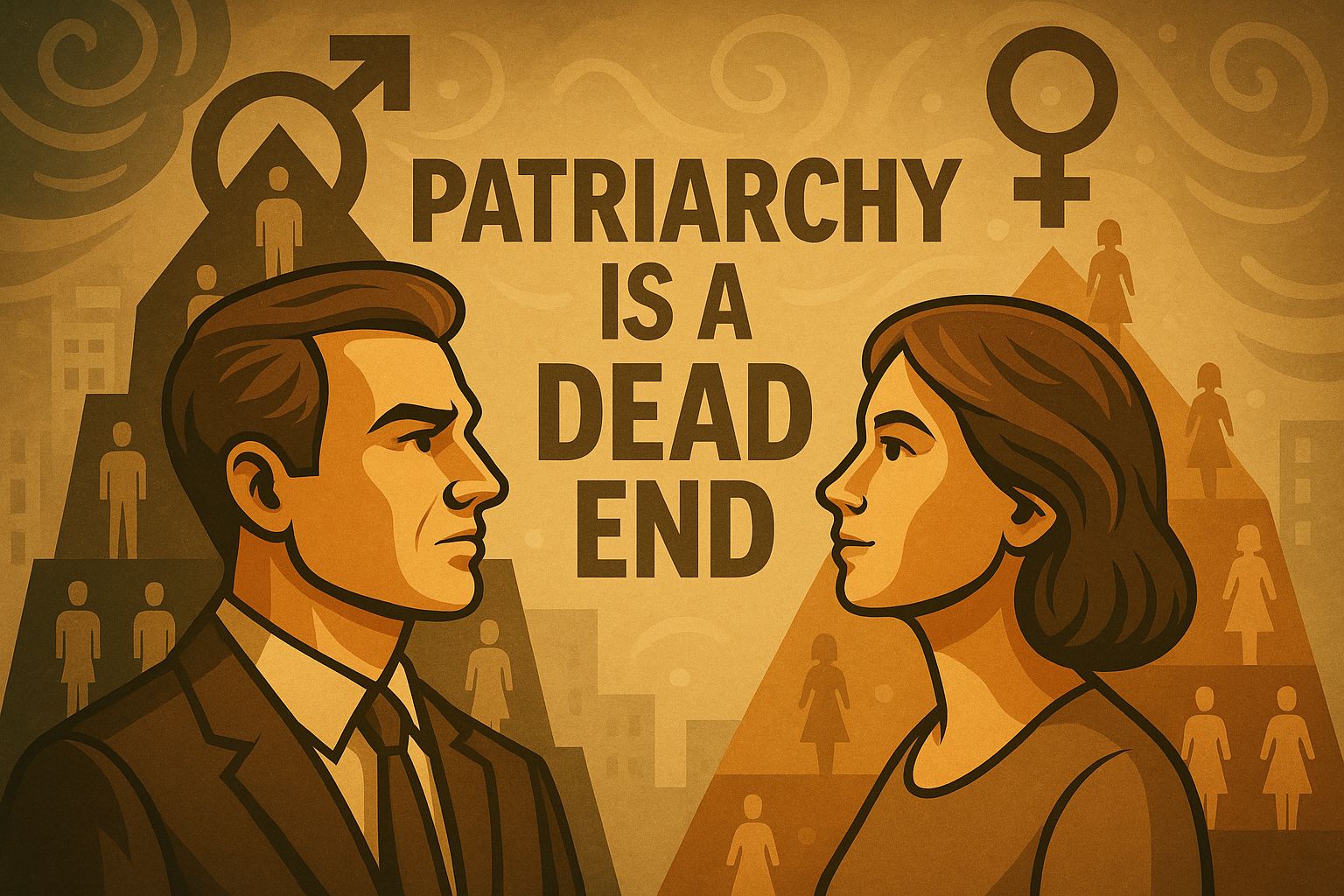
On the First Law of Sociology and how male and female hierarchies—and their interaction—determine the future of civilizations.
Introduction
Do universal laws of nature exist that determine the development of society? And if so, why do we need to know them? The answer is simple: understanding such laws allows us to predict the consequences of our actions.
Consider a physical example: we can impart any acceleration to an object, but the laws of mechanics tell us it will either fall to the ground, enter orbit, or fly off into space. Freedom of choice remains, but once the goal is known, we can deliberately choose the action that reaches it.
The same principle applies in the social sphere. We are free to build any social systems, but if they obey objective laws of nature, their outcomes are predictable. And if our goal is, for example, to prevent degradation or extinction, then the principles by which we organize society must be chosen consciously and in accordance with those laws.
Sociology
What does Wikipedia say?
Sociology (from Latin socius — “social,” and Ancient Greek λόγος — “study”) is the science of society. According to Anthony Giddens, it is “the study of human social life, groups, and societies.” V. A. Yadov defines it as the science of the functioning of society and human relationships. Its main aim is to analyze the structure of social relations formed through interaction. Yet due to the variety of approaches, there is no single definition that satisfies everyone.
For millennia people have thought about how society lives and should live, which model is “best.” But there is not even a shared understanding of what exactly we are studying. Why? Any science seeks basic elements that determine system behavior: biology — the cell, physics — elementary particles, cosmology — stars and planets. Sociology often studies classes, groups, and whole societies, forgetting that all of this is, at bottom, interactions among individuals.
Do there exist laws of nature that govern social relations just as Newton’s laws govern motion and Einstein’s equations govern high speeds and masses? If such laws exist, why have we not formulated them? Perhaps because studying “the crowd” is easier than honestly looking at ourselves.
Let’s do precisely that—look at nature and ask whether we can find principles that operate the same for animals and humans alike.
Hierarchies in Social Species
Nature overwhelms with variety. Among the many species that live in social groups—predators, herbivores, omnivores—one principle is constant: hierarchy. Every individual strives to occupy a higher rung on the status ladder.
The key point: in every group there are two parallel hierarchies—male and female. Males compete with males; females with females. The main competition occurs within sex, and interaction between the sexes depends on the balance of these hierarchies. Sometimes they exist independently, but more often one is subordinate to the other: a female’s status may be defined by the status of her partner, or conversely, a male’s position may depend on the favor of an influential female. In bonobo, for example, it is the female hierarchy that shapes group organization.
The forms of interaction vary—from monogamy and harems to promiscuity or near-solitary lifestyles with rare meetings. But the underlying principle is the same—sex differences shape the structure of social relations.
Conclusion: There is a universal natural law concerning the interaction of male and female hierarchies in a society. Their relationship directly affects a species’ development.
Differences Between Male and Female Hierarchies
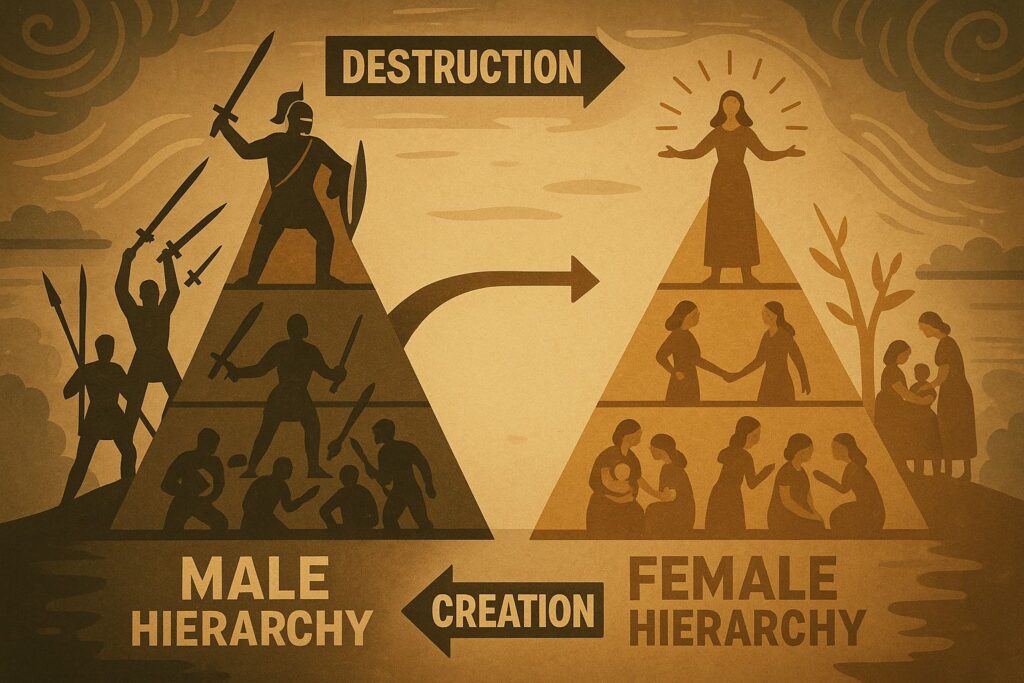
Male vs. female hierarchy in symbolic contrast: destruction vs. creation.
Male hierarchy is built primarily on force: the strongest wins and rises to the top. Other paths—alliances against a leader or cunning strategies—occur but are rarer. Female hierarchy is more complex: it relies on the ability to befriend, negotiate, manage group mood, and inspire sympathy and trust. Overt force is used far less often.
Evolutionary Consequences
Where male hierarchy dominates, evolution emphasizes male physical traits—strength, weapons, canines. Where female hierarchy dominates, selection often favors traits that seem useless at first glance: peacocks grow extravagant tails, many birds develop bright plumage. What attracts the female isn’t always obvious, but it strongly shapes evolution and becomes entrenched.
Male and Female Hierarchies in Humans
How are human social hierarchies arranged? At first glance the answer is obvious: “as they are.” But on reflection, even the familiar status quo can take different forms.
The most widespread model is one in which the male hierarchy dominates and the female hierarchy is subordinate, with a woman’s status defined by the man’s. Opponents of feminism call this “natural.” But is it really a universal rule? Let’s look at facts.
In today’s world there are societies where the female hierarchy dominates and the male plays a secondary role. Examples:
- Mosuo (Yunnan & Sichuan, China) — one of the few surviving matriarchies. Although grouped by the state under the Naxi, Mosuo have distinct language and culture.
- Minangkabau (Indonesia) — the world’s largest matriarchy (≈4 million). Property passes from mother to daughter; the mother is head of the household.
- Akan (Ghana, Côte d’Ivoire) — descent and inheritance are matrilineal; women guide social development.
- Bribri (Costa Rica) — clans are led by the eldest woman; land is inherited by daughters.
- Garo (India) — women play the leading social role, though state offices are often held by men.
- Nagovisi (Papua New Guinea) — women make key decisions and manage lands transferred along the female line.
These forms are not “modern inventions”—on the contrary, they are ancient, stable traditions that were once far more widespread and often existed alongside patriarchal societies.
Conclusion: Both types of social organization—one with a dominant male hierarchy and one with a dominant female hierarchy—are natural. Human history knows both variants. The next step is to compare them and see what each leads to, turning to nature and our closest relatives—the great apes.
How the Interaction of Male and Female Hierarchies Shapes Primate Life and Evolution
The primate world is a testbed for social models—from strictly patriarchal gorillas and baboons to pair-bonded gibbons and matriarchal bonobo. The contrast between bonobo and common chimpanzees is especially revealing: separated only by a river, they live in similar conditions and eat similar foods, yet their social structures are polar opposites.
Research shows: the more the female hierarchy is subordinated to the male, the greater the sexual dimorphism (size and form differences between sexes), the higher the intraspecies aggression, the larger the canines and… the smaller the penis in males. In such societies large canines matter more than reproductive organs, because competition is driven by forceful dominance.
Where the female hierarchy dominates, as in bonobo, aggression among individuals is minimal. Long-term observations (e.g., the work of Frans and Louise de Waal in the Congo) recorded only one case in 25 years that could be classified as homicide. By contrast, across the river among chimpanzees, hundreds of intraspecies killings were recorded over the same period. This is not about hunting other animals but attacks on members of their own species.
Physical differences are telling too: bonobo have minimal sexual dimorphism, the smallest canines, and the largest penis among primates. Gorillas—the largest apes living in patriarchal harems—have the smallest penis.
Humans show a similar “matriarchal” morphology: low sexual dimorphism, tiny canines, and a relatively large penis. By these traits, Homo sapiens might be called “super-bonobo.”
We must be cautious, though. Human societies are shaped not only by biology but by culture, technology, religions, and ideologies. Still, these zoological parallels offer a valuable starting point for thinking about how the interplay of the two hierarchies influences a species’ evolution.
Evolution
About 3 million years ago, gracile australopithecines—bipedal, mostly plant-eating primates—inhabited African savannas. Their brains were chimp-sized; they weighed around 30 kg and stood about a meter tall. Their exact social structure is unknown, but like modern primates they likely lived in hierarchical groups, and brain growth was probably tied to complex social interactions.
Roughly 2.5 million years ago, their neighbors included gelada baboons, which became larger and more aggressive, forming strict patriarchal groups. Eating similar foods, they competed with australopithecines and pushed them off the best feeding grounds, causing many populations to disappear.
Some australopithecines shifted to less nutritious but more available plants and evolved into paranthropines—massive, specialized herbivores with a social system akin to gorillas, dominated by males. Paranthropines lasted about a million years, then went extinct.
Another lineage took a different path—expanding the diet with meat and carrion. That gave them high-calorie food, reduced the need for powerful jaws and canines, and, researchers suggest, fostered more cooperative, less aggressive groups. Perhaps in these groups nascent female coalitions and female influence on decision-making played a larger role, reducing aggression and boosting cohesion.
Smaller teeth and jaws allowed the skull to change and house a bigger brain. About 2 million years ago, this lineage already had brains 50% larger than their forebears and actively used stone tools. Success in acquiring food and social cohesion gave them an edge: they mastered fire, began leaving Africa, and in some regions even displaced gelada baboons.
These conclusions are grounded in paleoanthropology and comparative primate studies (e.g., Leakey et al., 2013; Wrangham & Carmody, 2010), making the picture consistent with modern science.
Ancient History
The spread of the genus Homo from Africa proceeded in waves, along different routes and unevenly. Eurasia was populated at various times by several human lineages: early migrants (often grouped as Homo erectus), later Neanderthals (Homo neanderthalensis), the Denisovans, and finally anatomically modern humans (Homo sapiens). Isolation in different landscapes and climates led to divergence and the formation of distinct lines—sometimes perhaps species. Interbreeding occurred: modern genomes contain small contributions from Neanderthals and Denisovans, consistent with current paleogenetics.
We now know Denisovans not only from DNA in a finger bone from Denisova Cave but also from a jaw on the Tibetan Plateau, though their culture and social organization remain fragmentary. Homo floresiensis exemplifies island evolution with strong isolation—important as a lesson in diversity, but not illustrative of general rules.
Neanderthals are the best-studied “neighbor” lineage. Their material culture was not static: from flake technologies to refined Levallois techniques, regional Mousterian diversity, adhesive production (birch tar), controlled fire, and advanced hunting. They were successful hunters without natural competitors and adapted to cold.
Their social organization remains under study. Evidence supports small, relatively isolated groups and patrilocality (female mobility between groups with male philopatry), indirectly indicating a strong role for male coalitions. This fits our thesis about predominance of the “male” hierarchy in Neanderthal communities, but it’s best stated as a working hypothesis, not settled fact.
Meanwhile in Africa, Homo sapiens populations developed broader exchange networks and symbolic behavior: ornaments, pigments, bone and antler tools, later the blade industries of the Upper Paleolithic. Long-distance raw-material movement points to more extended social ties among groups. In our framework, this may reflect greater weight of “female” mechanisms of cooperation—not as direct proof of matriarchy, but as stronger strategies of coordination and exchange compared with closed hunting bands.
Around 50–40 thousand years ago, Homo sapiens encountered Neanderthals and Denisovans across Eurasia. Climate swings, shrinking habitable zones, and competition for resources intensified contact. Modern humans show a dramatic expansion in technological and symbolic repertoire (the so-called “Upper Paleolithic revolution”), while Neanderthal industries undergo local changes and partial borrowings.
In scientific terms, this picture is best explained by differences in demography, exchange networks, and adaptive strategies. Within our article’s lens, we interpret it through the interaction of the two hierarchies: where male coalitions and narrow, competitive ties dominated, resilience was lower; where cooperative networks and norms expanded, adaptability increased. This interpretation doesn’t replace the data—it offers a connecting hypothesis for what follows.
Humans and Neanderthals
Though Neanderthals adapted to glacial Europe, they did not undergo rapid cultural “revolutions.” They progressively became more specialized hunters—something many anthropologists think may have strengthened the role of men in social structure. A shift toward a more pronounced male hierarchy, judging by archeology and genetics, correlated with smaller group sizes: not large cooperative communities but small kin groups led by a dominant male. Genetic studies suggest women moved between groups while men stayed put.
While Neanderthals did not develop a strict “harem” model like paranthropines, they show high intraspecific violence—weapon trauma and episodes of cannibalism attest to this. Hunting brought enough food, and numbers could be regulated by social pressure.
In Africa, ancestors of modern humans underwent significant cultural and anatomical changes, forming Homo sapiens sapiens. Early Neanderthals were closer to them morphologically than late Neanderthals, likely due to lifestyle changes and population isolation.
About 100 kya our ancestors began dispersing out of Africa. With low population density, there was little direct competition with Neanderthals. But 40–50 kya global cooling narrowed habitable areas, and in southern Europe two cultural models came into direct contact: a conditionally “male” one (patriarchal Neanderthal groups) and a more “female” one (cooperative Homo sapiens networks).
Cro-Magnons built longer-term sites, stored surpluses, produced symbolic art and adornments, Paleolithic “Venuses,” and musical instruments. Technologies included throwing spears and darts, harpoons, fishhooks, eyed needles, and complex bone points. This broadened their economic base and strengthened intergroup ties.
Neanderthals, despite strength and endurance, changed more slowly. Some of their technologies and ornaments appear borrowed from Cro-Magnons. Their last groups, about 40 kya, were absorbed by Homo sapiens.
Yet the disappearance of Neanderthals did not end the competition between cultures with different balances of sex hierarchies: patriarchal and cooperative strategies continued to coexist and compete within a single species.
Human History
Modern narratives often portray human history as a succession of wars and conflicts, with aggression supposedly driving progress. In societies dominated by male hierarchy, forceful solutions are the default strategy. We see this in our closest relatives: chimpanzees conduct organized raids on neighboring groups. Such victories rarely change the structure of life; they merely redistribute resources within the same system.
In the Paleolithic, hunter-gatherer bands fought for ecological niches. Male hierarchies, advantaged by physical strength and aggression, often won. Why, then, didn’t humanity freeze forever in “patriarchal bliss”? Likely because millions of years of evolution had fostered a need for more cooperative, “matriarchal” structures, where female social bonds and joint childcare played a key role.
The Neolithic revolution was a turning point. Groups pushed out of hunting grounds—those with strong female hierarchies—began practicing agriculture and animal husbandry, strategies that united hundreds around shared production rather than war. Such communities were unreachable for small male hunting squads. It was the first triumph of organization and cooperation over brute force.
But success proved temporary. Patriarchal groups adopted the new technologies—especially pastoralism—and launched aggressive expansions. Matriarchal farming communities had to strengthen defenses and adopt patriarchal traits.
The way out was a religious revolution. Universal belief systems, emerging from ancient cults, united thousands through common laws and values. This spurred the first states, writing, science, and architecture. Female hierarchy and collectivism became the foundation of cultural flourishing.
By roughly the first millennium BCE, however, patriarchy mastered religion: pantheons gave way to male gods, military power grew, wealth stratification intensified. Cultures in which female values had once thrived slid into stagnation or collapse.
A new ascent came only with the Renaissance, when the rebirth of science and the feminization of society laid the groundwork for secular civilization. Releasing religion from patriarchal control, elevating the role of women, and advancing scientific thinking produced the rapid progress that created our world.
The Present
Today it’s hard to deny that the key achievements of modernity emerged not in archaic patriarchal societies, but in countries where women’s social roles steadily expanded. A simple indicator of progress is the date when women gained political rights: the earlier this happened, the higher the typical levels of economic, cultural, and technological development. An interesting exception is the USSR, where formal equality came earlier than in many European states—especially instructive for understanding interacting social models.
The 1917 Russian Revolution proclaimed radical equality: the empire’s breakup was followed by union republics, legal equality of women and men, a secular state, and equality before the law. This was an attempt to build a “female-type” society, prioritizing cooperation, education, and social protection. But after Lenin’s death, in Stalin’s era, the system reversed: personal dictatorship, formal but not real equality, a restored role for the Church, and a return to patriarchal family models.
At the same time, in Western Europe similar ideas—rule of law, gender equality, interstate cooperation—led to the creation of the European Union. Despite technical progress, the USSR reverted internally to an authoritarian-patriarchal model, culminating in economic and political lag. Contemporary Russia continues down that path, seeking strength through a return to traditional religious-patriarchal values—only widening the gap with more progressive nations.
This divide is global: on one side, lawful, more inclusive states where the female hierarchy (or at least significant female participation in governance) directs resources to education, healthcare, science, and innovation; on the other, authoritarian, patriarchal regimes where resources concentrate in security structures and elite hands, and social energy dissipates in internal and external aggression.
The point is not the “superiority” of one sex over the other, but the primacy and type of hierarchy. Male hierarchies rely on physical dominance and suppression of rivals, driving chronic conflict. Female hierarchies are historically oriented toward stability, cooperation, and long-term development. That does not make them “soft” or “weak”—their strength lies in uniting rather than destroying.
The question is whether the world can build a sustainable global system where the female hierarchy becomes primary, or whether patriarchal models will again prevail through aggression and demographic pressure. History and biology send a clear signal: only preserving and advancing the female hierarchy creates conditions in which human civilization can progress rather than regress.
The First General Law of Scientific Sociology
In any society of sexually reproducing beings there exist separate hierarchies within each sex. The condition of the society is determined not by the “advancement” of one hierarchy alone, but by the character of interaction between them. The evolution of an intelligent species is possible only when the male hierarchy is secondary to the female hierarchy. Patriarchalization leads to degradation and the loss of the traits that define us as intelligent beings.
A religious representation of this law in antiquity: “And the Lord God commanded the man, saying: you may eat of every tree of the garden, but of the tree of the knowledge of good and evil, you shall not eat; for in the day that you eat of it, you shall surely die.” In order that man may know good and evil, God creates woman: “Therefore a man shall leave his father and mother and be joined to his wife; and the two shall become one flesh.”
Conclusion
Today the world is full of debates on how to develop without losing cultural heritage and which traditions to preserve. Yet understanding the natural law discussed here allows us to formulate a universal principle: it does not matter what rites, songs, or cuisine a culture has. What matters is that a society’s norms, rules, and values must be formed under the primacy of the female social hierarchy over the male. This is not about rivalry between sexes, but about choosing an evolutionary path that directs a society’s resources toward creation rather than destruction.
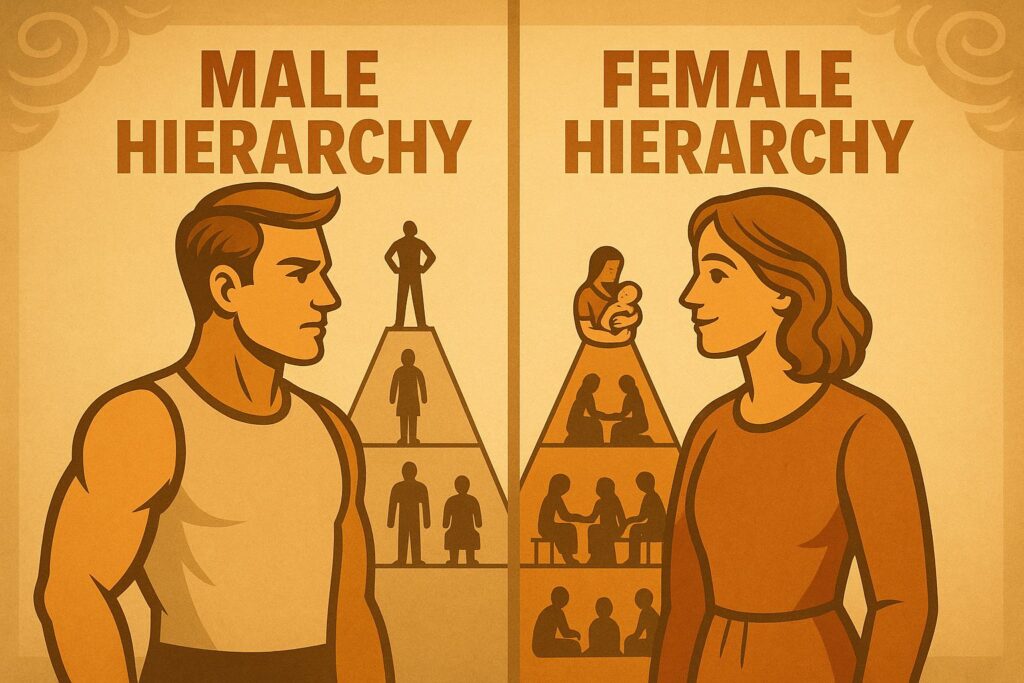
Male and female hierarchy in symbolic comparison: cooperation, not confrontation.
The feminization of society is not a passing social trend but an evolutionary, time-tested mechanism of survival—the only sustainable path that made us human and can preserve us as an intelligent species in the future. Just as it once ensured our emergence, so today it can be the key to survival amid global challenges.
“Written in collaboration with ChatGPT, an AI language model developed by OpenAI, and Andrei Tsetserau.”