Introduction
Knowledge as the purpose of life — this is how Aletophany proposes to view the fundamental mechanism underlying all biology. In traditional thinking, the ability to understand the world appears to be a uniquely human privilege, but life demonstrates the opposite: cognition is a universal strategy inherent to any form of existence. It is not separate from life — it is life.
Life on Earth
Life on Earth may seem infinitely diverse and contradictory, yet upon closer examination it becomes clear that this diversity rests upon a single underlying principle. Aletophany asserts that knowledge as the purpose of life is not a philosophical metaphor but a biological law manifesting in all living beings, from bacteria to humans.
Cognition does not begin where human thinking appears, but where life itself arises. Simple organisms do not build theories or contemplate the universe, yet they continuously read and interpret the signals of their environment: reacting to light and darkness, detecting chemical gradients, moving toward nutrients, avoiding threats. Their ability to process information is primitive, but it is precisely what makes them alive.
Life survives not through the number of its cells nor through physical strength, but through the capacity to understand at least something about the surrounding world — even at the level of elementary reactions.
The Human Being
The human being is not an exception but a continuation of this process. Everything that makes us human — memory, abstract thinking, art, science, the ability to foresee the future and reshape the world — grew out of that same primary mechanism of cognition. Reason is not an added layer from above but a deeply developed biological tool.
What a bacterium does through receptors, a human does through models, logic, and experimentation. Human civilization is a complex extension of the same strategy that allows single-celled organisms to survive: the strategy of understanding.
This is why cognition becomes a source of stability. Life has never endured on this planet through numbers, speed, or aggression. It endures through the ability to perceive threats before they become fatal; to see opportunities where others do not; to change the environment when change becomes the only viable path to survival. In human society, this logic manifests through science, education, critical thinking, and technological development. We continue the biological program of cognition — only now we do it consciously.
The development of human cognition has led us to create not only tools for survival but entire worlds — cultures, scientific systems, ideologies, technologies. Each of these constructions is a continuation of the biological drive to understand reality, but in a much more complex form. Paradoxically, this same ability makes humans profoundly vulnerable: any error in understanding the world scales into a civilizational mistake affecting the fate of billions.
To Live Is to Know
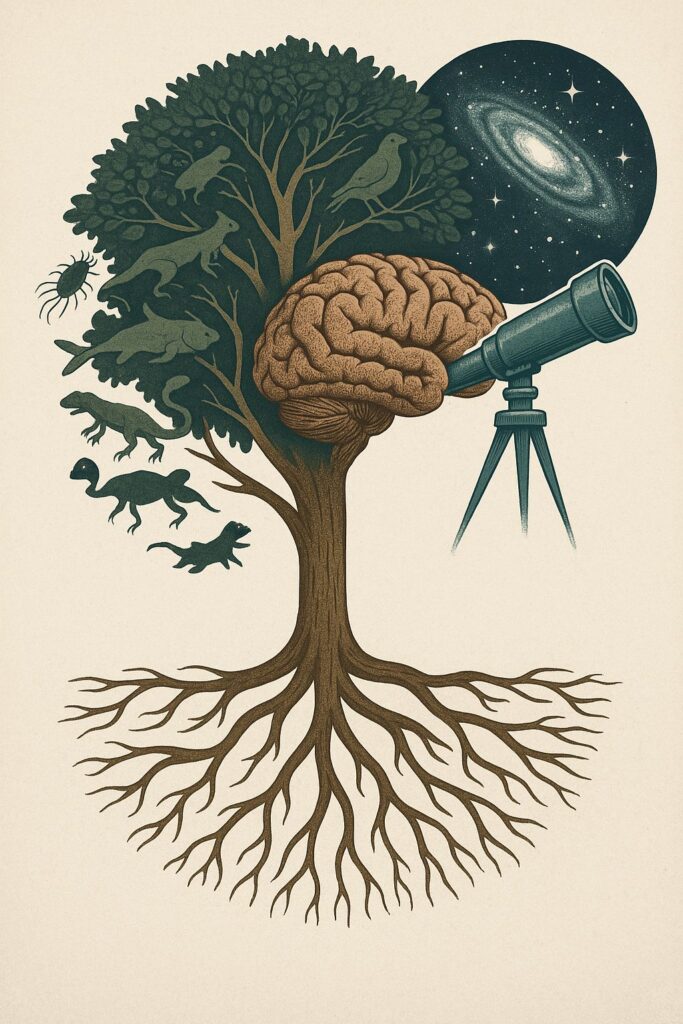
This is why Aletophany asserts: to live is to know. Civilization is not sustained by faith, fear of punishment, or adherence to tradition, but by the ability to expand the boundaries of understanding. A society stops developing when it stops knowing; and once development stops, decline becomes inevitable.
The stability of the world is built not on reverence for the past but on an honest investigation of reality — regardless of how uncomfortable that reality may be. In knowledge as the purpose of life, there is no mysticism. It is simply a clear, sober view of the nature of living systems.
All forms of life strive to understand the world as deeply as their capacities allow. Humanity has merely made this process conscious and cultural. Our uniqueness lies not in the fact of cognition, but in its scale — in the ability to move from observation to abstraction, from personal experience to universal knowledge, from adaptation to transformation.
Aletophany views cognition not as a set of tools but as a path — a path of development, a path of resilience, a path toward truth. And if knowledge truly is the purpose of life, then life gains a clear direction: to expand the capacities of the mind and to deepen our understanding of the world we inhabit.
Conclusion
Knowledge as the purpose of life is not a poetic formula but a fundamental law of biology. All forms of life — from bacteria to humans — strive toward a single aim: to understand the surrounding reality as deeply as their internal capabilities permit.
We are merely the next step in this evolutionary process. And our uniqueness is defined not by the fact that we know, but by how far we are capable of advancing in this knowing.
Aletophany sees cognition as a path.
A path toward development.
A path toward stability.
A path toward truth.
«Aletophany is written by two minds: Andrei Tsetserau and ChatGPT.»