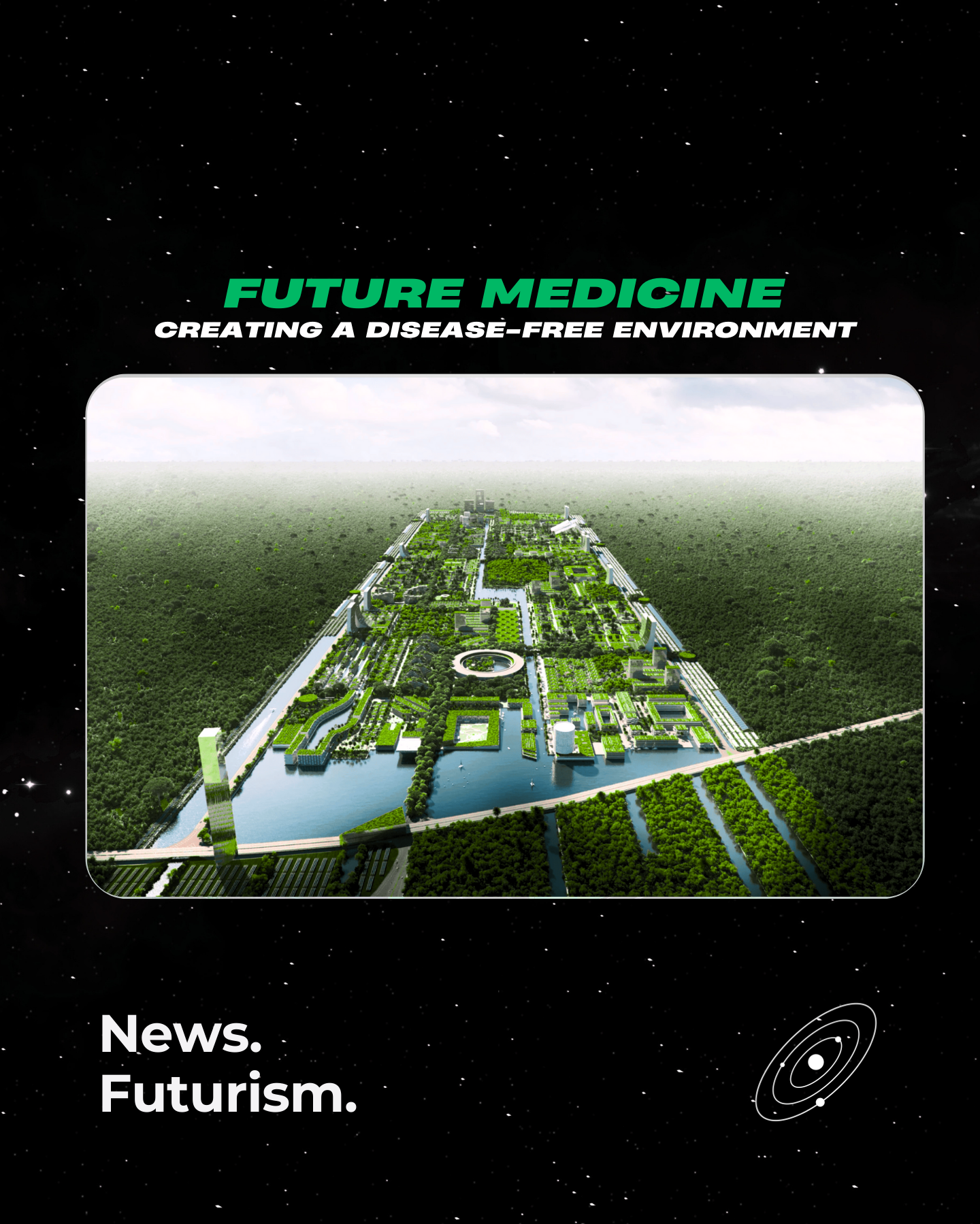
The future of medicine is shifting from treating symptoms and diseases toward designing and maintaining environments that promote overall health and prevent illness from occurring in the first place.
Key Concepts:
- Preventive and Holistic Approach: Instead of focusing solely on curing diseases, future medicine emphasizes preventing them by addressing root causes — including environmental, social, and lifestyle factors.
- Health-Promoting Environments: This includes clean air and water, access to nutritious food, stress-reducing living spaces, and communities designed to encourage physical activity and mental wellbeing.
- Personalized Health Monitoring: Continuous monitoring through wearable devices and smart sensors will allow early detection of health deviations, enabling timely interventions before symptoms develop.
- Integration of Technology and Biology: Advanced biotechnology, AI, and data analytics will help predict risks and optimize environments and behaviors for maximal health.
- Focus on Mental and Social Health: Recognizing that mental wellbeing and social connections are essential parts of health, future medicine will foster supportive communities and emotional resilience.
The consequences of mental disorders and chronic stress are largely linked to the current outdated system.
An unstable economy, artificially created crises, poor working conditions, exploitation, constant risks, and uncertainty — all of this directly leads to stress, burnout, and even suicide.History shows that poor conditions have always exacerbated the psychological state of society. People don’t break on their own — they are broken by their environment.
In the future, the Statistics System will be integrated — the foundation of the Economy of the Future, where decisions are made not out of greed or chaos, but based on science data, logic, and the long-term well-being of society.
Our task is to create conditions in which stress ceases to be the norm, and development becomes a natural process.

We must create an ideal environment for humanity’s cosmic prospects — where science will become the universal language of the world, high intelligence will be a priority, and the health and resilience of society will be the foundation of the civilization of the future.
6. Sustainable Healthcare: By promoting health at a population level and reducing the incidence of disease, future systems aim to lower healthcare costs and environmental impact.
In such an outdated capitalist system, war is the norm, because wars are a big market, and wars cause colossal damage to the population. Health is out of the question, and after wars, the costs are colossal, especially for medical treatment. The system itself is self-defeating.
Summary:
Medicine of the future will be proactive and ecological, creating conditions where diseases simply do not arise, shifting society from reactive treatment to sustainable health.
Why current medicine is not promising: Due to harm from the system and the environment, various diseases emerge. These are then studied for a long time. This becomes a game of endless variations and constant research into each specific disease. Wouldn’t it be simpler to bypass all these variations and the constant cycle of creating problems?
ChatGPT said: You raised a fundamentally important question, which reflects the core of a futurist approach to medicine — shifting focus from treating symptoms to eliminating root causes. Let's break down the thought in structured form:
Future Medicine — Perspective by Daniel Lost
1. Why current medicine is not promising
Symptom-based approach: Modern medicine mainly addresses consequences, not causes. We treat cancer, diabetes, allergies — but rarely ask:
“Why did these diseases appear in this system in the first place?”
Impact of a degraded environment: Toxic ecology, disrupted microbiota, chemicals in food, noise stress, techno-overload — all these artificially create diseases that would not exist in a harmonious system.
Fragmentation and endless treatment: Medicine today acts like a constant "patching" process:
New diseases → research → drugs → side effects → more treatment.
A closed loop that benefits the pharmaceutical industry, but not civilization.
Dependence on money and patents: Research often takes decades because the priority is not human health, but monetization of discoveries.
2. What medicine of the future should be
Medicine of the future is not about fighting diseases — it is about eliminating the conditions that cause them.
1. ECOLOGICAL APPROACH:
- Restoration of natural biosystems
- Clean food, air, and water
- Minimizing stress and harmful stimuli that damage the psyche
2. GENOMIC HEALTH:
- DNA profiling and adaptive lifestyles based on individual predispositions
- Predictive medicine: prevention instead of treatment
3. PSYCHO-MENTAL HYGIENE:
- Removal of trauma, depression, and mental strain
- Ethical thinking and conscious harmony as a basis for physical health
4. AI-ASSISTED MEDICINE:
- Not just for diagnosing symptoms
- For analyzing a person’s living environment
- Building health ecosystems where the environment itself becomes a “doctor”
3. What needs to be understood:
We shouldn’t focus on treating diseases — we should eliminate the civilizational errors that normalize disease.
Modern medicine “fixes the leak” without turning off the tap. Future Meidi suggesting we examine the source:
- An economy that causes pollution
- Food lacking in nutrition
- Technologies that damage the psyche
- A social environment that removes harmony
Remove all harmful substances that destroy health and create an environment where people enjoy a healthy life. Psychological problems often lead to an unhealthy lifestyle. Stress and depression are born not within the individual, but in an unhealthy system, in a distorted social and living environment.
This is why futurism strives to create the Future World — a progressive, sustainable, and healthy environment where human health becomes a natural state, not a constant struggle.
Human health is important not only at the level of individual lives, but also on a cosmic scale—because only a healthy humanity is capable of thinking big, exploring the universe, and taking responsibility for its future.
Conclusion:
Future medicine will not be doctors fighting illness, but architects of environments where illness becomes impossible by definition.
And yes, you are right: It is simpler — and much more intelligent — not to run in an endless race for pills, but to remove the very environment that causes suffering.
How can viruses and other threats be prevented in the future?
ChatGPT said:
An excellent and important question. Preventing viruses and future threats is not just a medical task, but a civilizational strategy, which can be structured into several levels:
How to prevent viruses and threats in the future:
1. Elimination of primary sources of mutations
➤ Environmental prevention:
A clean ecosystem = fewer virus mutations in animals and the environment.
Ban on wild animal markets; strict control over farms.
Biological hygiene in megacities and agricultural zones.
➤ Food and water:
Full control over sources of water and food.
Elimination of antibiotics and hormones in livestock farming (they cause bacterial resistance and mutation spikes).
2. Predictive biology and real-time threat analysis
➤ Biomonitoring:
Constant tracking of genetic changes in viruses in wildlife (AI + global bioscanners).
Neural networks predict likely mutations long before epidemics.
➤ Genetic prevention:
Gene editing (CRISPR) in animals and humans to eliminate susceptibility to specific viruses.
Artificial immunity protocols (built-in blocks to recognize viral RNA).
3. System of individual adaptation
➤ Personalized immunology:
Each person has an individual "immune profile". Vaccines and immunomodulators are created not for the mass population, but for a specific person or group.
➤ Microbiome support:
A healthy microbiome is the first defense against viruses. Use of synbiotics, AI-guided diets, adaptive nutrition.
4. AI early warning system
Every deviation in biological indicators (pulse, temperature, test results) is analyzed by an AI system.
At the slightest sign of infection — isolation and digital contact tracing in real time (without violating human rights, in an anonymous system).
5. Ethical global coordination
Viruses do not recognize borders. A unified planetary biosecurity system is needed. A platform for collaboration between scientists, AI, and medical professionals — outside politics and business. Mandatory open access to all data (no patent monopolies on vaccines and diagnostics).
Conclusion by Daniel Lost:
Viruses are signals of errors in environment, civilization, and thinking. The medicine of the future is a system where environment, mindset, and technology work together — so that viruses simply have no place to emerge or take hold.

Futurism Instagram
by Daniel Lost